
Blog

Lowcountry Loggerheads
Lowcountry Loggerheads
Loggerhead sea turtles are found on the Atlantic coast, especially along the Lowcountry barrier islands from Charleston, SC to Savannah, GA.
Their numbers have been dwindling and they are on the endangered species list.
The main threat to the adult loggerheads comes from shrimp trawlers and fishing nets. Thanks to better net design and turtle activists, 2008 brought some good news: the number of hatchlings this season is much higher than in recent years.
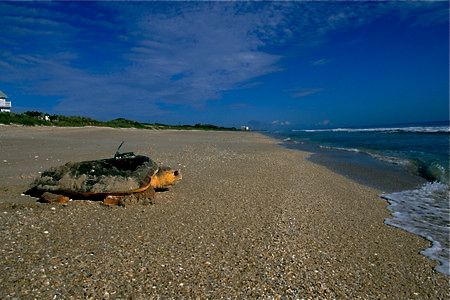
(above)
Adult loggerhead after laying eggs (with tracking device on her shell).
The turtles lay from 70 to 150 eggs per nest, dug along the high water mark of a soft sandy beach, such as Tybee Island, Hilton Head, Hunting Island, Folly Beach or the Isle of Palms. Each egg is the size and shape of a semi-soft ping-pong ball. Raccoons love the eggs and if they hatch at all the baby turtles begin a life-long struggle.
The hatchlings usually emerge at night when darkness protects them from predators. They follow the brightest light, assuming it is the horizon, so any artificial light can lead them astray. Coastal development has led many hatchlings astray.
If a hatchling finds the ocean and doesn't drown in a net before adulthood, loggerheads can live for longer than 30 years, and can often live past 190 years.
Their numbers have been dwindling and they are on the endangered species list.
The main threat to the adult loggerheads comes from shrimp trawlers and fishing nets. Thanks to better net design and turtle activists, 2008 brought some good news: the number of hatchlings this season is much higher than in recent years.
(above)
Adult loggerhead after laying eggs (with tracking device on her shell).
The turtles lay from 70 to 150 eggs per nest, dug along the high water mark of a soft sandy beach, such as Tybee Island, Hilton Head, Hunting Island, Folly Beach or the Isle of Palms. Each egg is the size and shape of a semi-soft ping-pong ball. Raccoons love the eggs and if they hatch at all the baby turtles begin a life-long struggle.
The hatchlings usually emerge at night when darkness protects them from predators. They follow the brightest light, assuming it is the horizon, so any artificial light can lead them astray. Coastal development has led many hatchlings astray.
If a hatchling finds the ocean and doesn't drown in a net before adulthood, loggerheads can live for longer than 30 years, and can often live past 190 years.
Leave a comment